In the heart of Biarritz
Terrace view, beach at your doorstep, swimming pool!
Style and comfort at the Grande Plage


BIARRITZ
YOU WILL LIKE ALSO
Official site of the City of Biarritz
Biarritz Tourist Office
Blog Biarritz Inspiration
The Biarritz Agenda
Biarritz Wikipédia
Biarritz Tourist Office Documentation
Beaches Infos & Tide time
Business Tourisme Basque Country, Béarn
A little history of Biarritz
In the 17th century, whales were hunted in Biarritz: a lookout stationed on the Atalaye promontory scanned the horizon, and as soon as a cetacean appeared, the men boarded the whaling boats anchored in the Old Port. The last cetacean was caught in 1686, and with the disappearance of this important source of income, sailors embarked on privateer ships or went fishing in Ireland and Newfoundland.
From 1784, sea bathing in Biarritz was fashionable, and Napoleon bathed there in 1808. Victor Hugo discovered the town in 1843. Napoleon III built a palace for Empress Eugenie, who, after staying there for two months in 1854, decided to make it her vacation home. Crowned heads from all over Europe followed, making the city a success, becoming "the queen of beaches and the beach of kings."
Count Gaëtan de La Rochefoucauld settled in Biarritz in 1873 and welcomed the luminaries of his time to his estate, including Queen Victoria in 1889 and Princess Youriewski in 1893. Biarritz still retains some reminders of the stays of the Russian aristocracy before the Revolution, such as an Orthodox church.
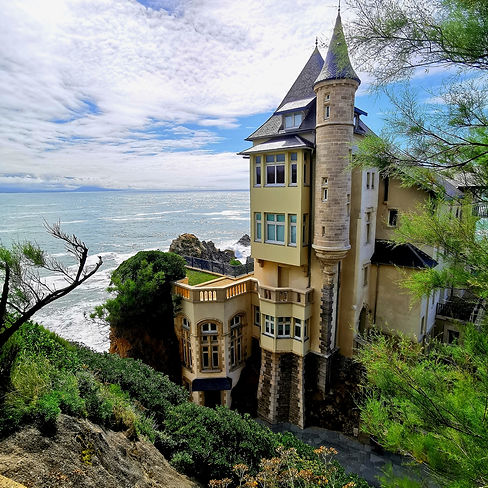
Since the rise of seaside resorts, illustrious visitors have left their mark by building private mansions, châteaux, and villas in various styles: neo-Basque (Villa Lou Bascou), neo-Norman (Villa Victoria), Belle Époque (Hôtel Bellevue), Art Deco (Museum of the Sea and Hôtel Plazza), or medieval pastiche (Villa Émilia, designed by Eugène Viollet-le-Duc), Renaissance (Château Boulart), and late Renaissance or Louis XIV style (Hôtel du Palais). However, a few remnants remain in the Port-des-Pêcheurs: small, rustic, whitewashed houses with colorful shutters, used to store fishing traps, buoys, and nets. Moving away from the coast, one finds the traditional urban style of the Labourdine house: whitewashed facades and exposed timber framing, most often painted reddish-brown, but also green, gray, or blue.
Queen Nathalie of Serbia laid the foundation stone of the Thermes Salines, which were inaugurated in June 1893. Water with a salinity ten times higher than that of seawater was transported from the Briscous saltworks through underground pipes over twenty kilometers long. These establishments were closed in 1953 and razed in 1968.
The Biarritz Bonheur department store (still in operation), where the majority of its employees speak English, is a temple of luxury and fashion. It opened in 1894, while Coco Chanel opened her third boutique in 1915.
In 1940, during World War II, the Germans dug the Atlantic Wall into the cliffs of Biarritz, and in March 1944, the city was bombed by Allied aircraft en route to destroy Parma Airport, after German anti-aircraft guns had shot down an aircraft during a previous overflight.
In 1956, American screenwriter Peter Viertel, passing through Biarritz, used a surfboard sent to him from California. Success! In 1959, Jo Moraïtz founded the Waïkiki, the Biarritz surf club. In 1960, the first international competition took place on the Grande Plage and the first edition of the French championships, the winner of which was Joël de Rosnay. Jo Moraiz and Jacky Rott participated in the 1962 World Surfing Championship in the United States and introduced their Biarritz surf spots to American competitors, which, by 1963, had also made Biarritz a household name in the international surfing world.
Source: Denisia Kerschova Podcast Musiques-les-Bains France Musique

Exceptional land and coast
The history of Biarritz, a discreet little Basque fishing village, is very old. The fame of Biarritz, a seaside town of international notoriety, is more recent. The birth of the city dates back to the second half of the 19th century, when Napoleon III and Empress Eugenie, the crowned heads of Europe and wealthy families of the time made this wild site one of the most famous destinations where is fashionable to have a residence. The beautiful residences of Biarritz testify to a glorious past where a wealthy society developed a sometimes unbridled taste for fantasy and exuberance.
In the 1920s, Biarritz was booming and tourism was developing. A regionalist architecture emerges, mixing the comfort of beautiful bourgeois villas with the specificities of the local architecture which constitutes the originality of the neo-Basque style which develops in Biarritz. At the same time, Art Deco made its appearance: the Municipal Casino, the Town Hall and the Plaza Hotel are the witnesses. At the bend of a street, at the end of an avenue, we discover villas where Art Nouveau, Art Deco or even Basque or even Norman neo-regionalism mingle. This astonishing architectural variety characterizes the identity of the city and gives it its charm.
Biarritz is a land of encounters, marriages and political arrangements: kings, emperors, princes, high‐ranking men, maharajas…presidents of the Republic and ministers have contributed to forging history there, the consequences of which can be assessed. at the World level. To receive, it was necessary to remain in the ostentation; this is what the city councilors from Biarritz and great personalities grasped, after the fall of the empire and after the wars, to meet the challenges of exceptional hospitality.
The presence of great characters led to the arrival of artists; a movement that has grown over time, and has continued from the Roaring Twenties to the present day; because it was necessary to "entertain"; entertainment opened the doors to creation. Much of the development of modern art was revealed in Biarritz: fashion, painting, theater and mainly dance and music. characterizes the identity of the city and gives it its charm.
Source: City of BIARRITZ – Area for the Enhancement of Architecture and Heritage (AVAP)
